
Connect advertising and customer context
Connect advertising signals and customer relationships while preserving their different permissions, identities and measurement limits.
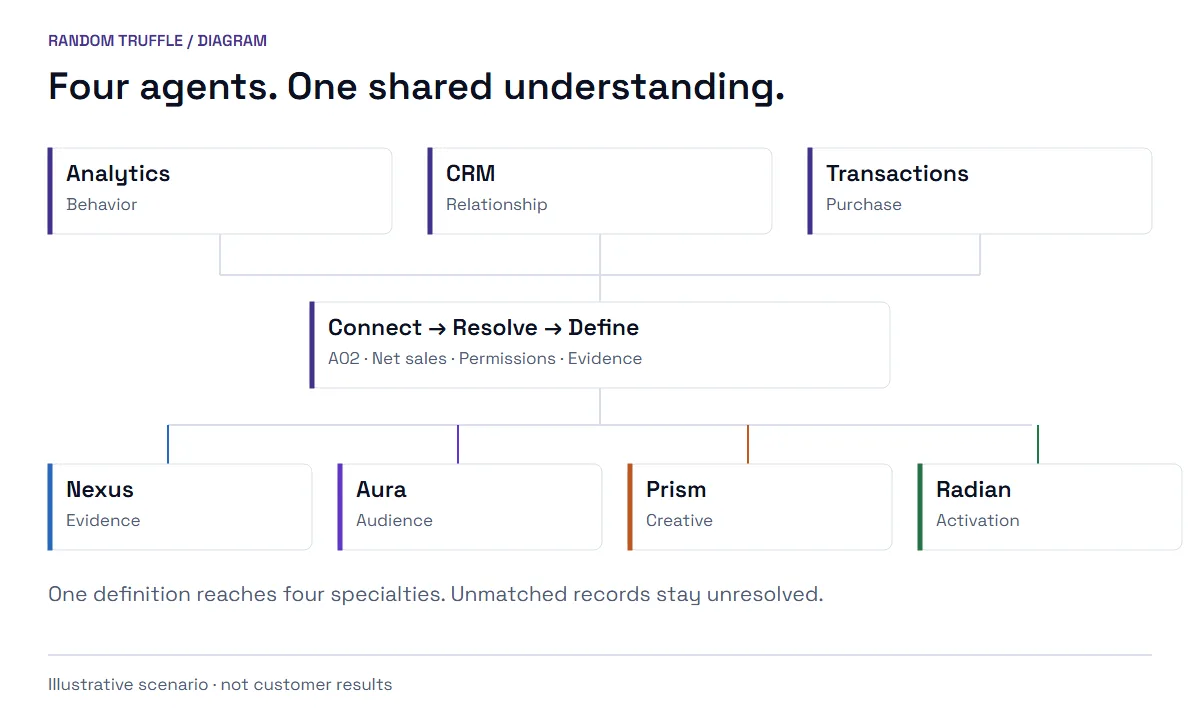
The digital marketing ecosystem is undergoing a violent, necessary, and ultimately beautiful structural transformation. For over a decade, we have operated in a divided world. In one corner, we had Advertising Technology (Adtech)—the loud, probabilistic hunters casting wide nets across the open web. In the other, Marketing Technology (Martech)—the meticulous, deterministic farmers nurturing known customers in walled CRM gardens.
Historically, these disciplines ran on parallel tracks. They served different organizational functions, spoke entirely different data languages, and were judged by divergent metrics of success.
But the walls are coming down. Driven by the rapid maturation of artificial intelligence, a barrage of global privacy mandates, and the systematic deprecation of third-party tracking, these two silos are colliding to forge a unified discipline: Madtech.
This convergence is not just a theoretical exercise in operational efficiency. It is a forced evolution. As marketers, data engineers, and analysts, we are stepping into an era where artificial intelligence moves from being a passive analytical tool to an active participant in cross-channel workflows.
Here is how the underlying data architectures, modular ecosystems, and AI agents are re-engineering the future of marketing.
The Historical Bifurcation: The Hunter vs. The Farmer
To understand the magnitude of this convergence, we must first look at the legacy architectures that kept Adtech and Martech separated for so long. The separation was a logical outcome of the early internet: the tools required to acquire an audience were fundamentally different from the tools required to manage relationships with known customers.
Marketing Technology was built for owned media. Think email platforms, loyalty programs, and enterprise CRMs. Its lifeblood was first-party data—deterministic identifiers volunteered directly by the consumer, like email addresses and physical addresses. The goal was customer retention, engagement, and maximizing lifetime value.
Advertising Technology, conversely, was built to conquer the paid open web. Programmatic bidding, display networks, and social algorithms ran on probabilistic data, anonymous tracking cookies, and device identifiers. The goal was aggressive net-new audience acquisition, optimizing ad delivery, and managing media spend efficiency across the digital expanse.
Think of it this way: Adtech was designed to find strangers in a crowded room. Martech was designed to remember their favorite drink once they sat at your table.
Because the datasets were fundamentally different—ranging from anonymous browser events to verified home addresses—the internal teams managing them were equally siloed. The result? Fragmented insights, disjointed customer journeys, and immense financial waste.
The Catalysts: Privacy, Regulation, and the Signal Collapse
The foundation of this bifurcated ecosystem began to fracture under the weight of compounding structural shocks. Sweeping global privacy regulations fundamentally altered consumer consent frameworks, making the covert tracking mechanisms of traditional adtech legally and operationally perilous.
Concurrently, massive technology gatekeepers instituted structural barriers that devastated the Adtech supply chain. The slow, chaotic death of the third-party cookie and the restriction of mobile device identifiers effectively severed the connective tissue of the open web.
Suddenly, advertising platforms—deprived of their anonymous tracking signals—desperately needed the deterministic, first-party data that Martech platforms had spent a decade safely and transparently aggregating.
This shift to first-party data is the reactive force compelling these two worlds to merge. When a customer downloads a whitepaper, receives a promotional email, and later sees a display ad on a publisher's site, that sequence can no longer be managed as disparate events across isolated departments. It must be tracked, understood, and optimized as a single, privacy-compliant journey.
Artificial Intelligence: The Engine of Convergence
If privacy regulations provided the necessity for integration, Artificial Intelligence is the sophisticated engine actively forging the two into a unified capability. The application of AI within these disciplines has evolved rapidly from basic, rule-based automation into embedded intelligence capable of predicting complex behaviors and generating creative assets.
1. Predictive Modeling in a Post-Cookie Reality
In the absence of third-party cookies, predictive AI has become the foundational mechanism for audience targeting. Advanced machine learning models now analyze first-party data alongside contextual signals—such as time-on-page, ambient attention indicators, and previous purchase history—to accurately predict consumer intent.
By identifying the characteristics of high-value known customers within a brand's CRM, predictive AI can scan the open web's programmatic inventory to find statistically identical lookalike audiences. This enables highly accurate, outcome-driven media buying that respects privacy compliance, modeling intent without relying on individual tracking.
2. Dynamic Creative Optimization (DCO)
Historically, creative effectiveness was evaluated through highly subjective heuristics or delayed post-campaign analysis. Through Generative AI, a single creative asset is no longer a fixed, immutable entity. It can be adapted into localized, contextually relevant variations.
These systems ingest live data feeds regarding audience intent, contextual environment, and historical performance to adjust imagery, messaging, and formats. This entirely bridges the gap between Adtech's demand for massive scale and Martech's demand for intimate personalization.
3. The Dawn of Agentic AI
The most transformative technological shift bridging these sectors is the transition from generative AI to agentic AI. Unlike traditional rule-based algorithms that follow strict "if-then" logic, agentic systems can understand contextual goals, formulate plans, and carry out defined steps of complex workflows within the access and limits they are given.
In a converged ecosystem, an agent can analyze cross-channel performance analytics, prepare bid and budget recommendations, and propose adjustments to subsequent email marketing triggers based on observed advertising outcomes, while people remain responsible for the consequential decisions.
The Architecture: Why Monoliths Will Fail
Given the profound capabilities of AI and the mandatory merging of these workflows, a fundamental question arises: Will all these processes eventually be managed within one single, monolithic software solution?
The answer is a definitive no. The industry is aggressively rejecting the "generalist monolith."
Massive, tightly coupled software suites struggle to adapt quickly to rapidly evolving privacy regulations, deteriorating data signals, and the blistering pace of independent AI innovation. Furthermore, attempting to combine disparate datasets with conflicting privacy standards within a closed, proprietary system often introduces critical compliance risks.
Instead, the future of this convergence relies on a composable architecture.
In a composable framework, the organization's centralized cloud data warehouse functions as the absolute, single source of truth for all customer data. By decoupling the storage of data from the activation of data, organizations achieve unprecedented flexibility. You don't buy a massive, rigid suite; you build an intelligent activation layer directly on top of your existing data infrastructure.
From this unified core, organizations can plug in, or "compose," best-of-breed marketing automation tools, demand-side platforms, and specialized AI agents via APIs. If an AI marketing agent requires upgrading, the modular component can be replaced without dismantling the entire underlying data infrastructure.
Therefore, the "one central solution" of the future is simply your foundational data layer. The execution interface will remain highly fragmented but tightly orchestrated by artificial intelligence.
Measurement in the Madtech Era
You cannot orchestrate a converged ecosystem with outdated measurement tools. In this new era, measurement requires a sophisticated, multi-layered framework that bridges the gap between tactical execution and strategic planning.
Data-Driven Attribution (DDA): DDA provides fast and granular feedback on which channels and tactics are more likely to contribute to a conversion within a customer journey. It relies on advanced machine learning to distribute credit across touchpoints, making it incredibly useful for day-to-day, tactical optimizations and bidding algorithms.
Marketing Mix Modeling (MMM): For strategic, executive-level planning, we are entering a renaissance of MMMs. Marketing Mix Modeling provides a holistic overview of all channels, sales, and external macro-factors (like seasonality or economic shifts) without requiring user-level tracking. It can work with aggregate data, though its privacy implications still depend on the data, processing and deployment.
The most advanced marketing engineering teams use a blended methodology. They use granular attribution for real-time programmatic bidding and short-term optimization, while relying on rigorous MMM for macro-level cross-channel budget allocation and incrementality testing.
The Human Takeaway
As these technologies mature, agents can take on more of the repetitive coordination work. But this does not render the marketer, the analyst, or the CMO obsolete. In fact, it elevates the human element.
As software takes on more technical execution—bidding, segmenting, basic copywriting—the value of human capital shifts further toward emotional intelligence, empathetic brand building, ethical data governance, and the formulation of overarching strategic narratives.
The competitive advantage in this decade will not belong to organizations with the most powerful algorithms alone. It will favor organizations that architect the most effective collaboration models between AI agents and deeply strategic, culturally resonant human leadership.
The walls are down. The data is unified. Welcome to the era of Madtech.
At Random Truffle, we believe the best marketing isn't just creative—it's engineered. By unifying cloud infrastructure, advanced analytics, and AI, we help brands build the central nervous systems their marketing actually needs. Marketing. Re-Engineered.
Four agents. One shared understanding.
Explore how Nexus, Aura, Prism and Radian turn a question into evidence, creative and action.
Meet the agents →Keep exploring.
 AI & marketing / 8 MIN READ
Measuring your brand’s visibility in AI search
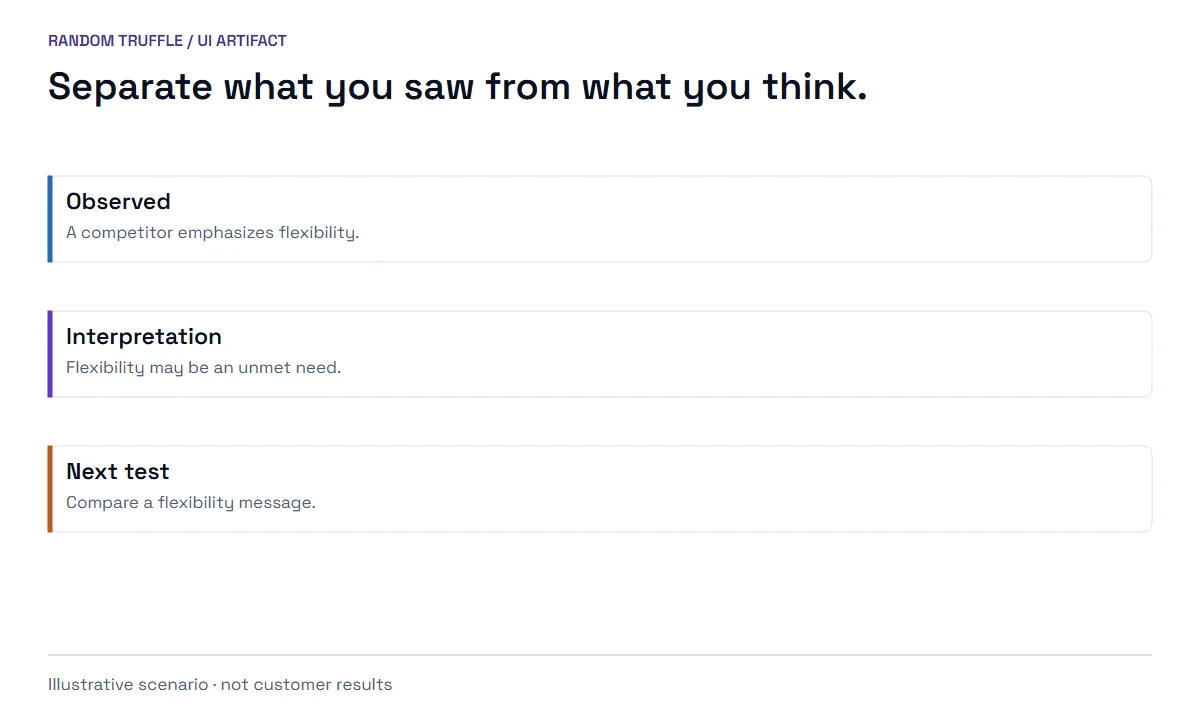
Build a repeatable set of buyer questions, inspect the sources cited and test whether clearer content changes the observed response.
Read the field note →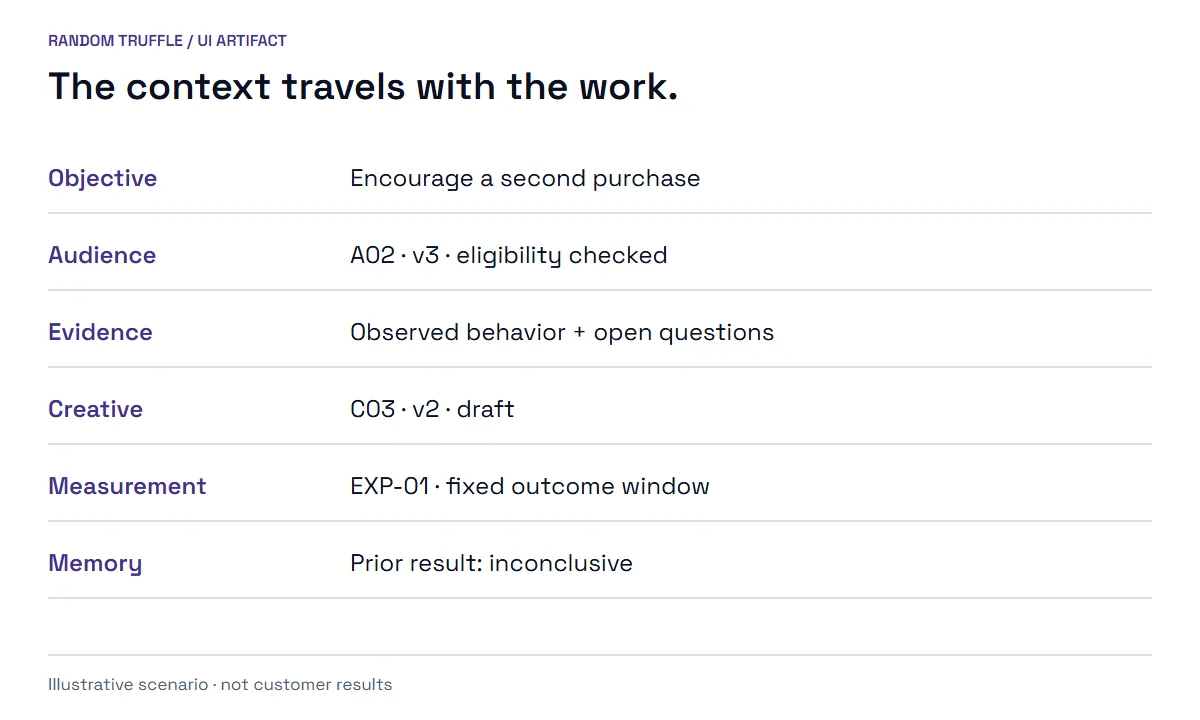 AI & marketing / 4 MIN READ
Give agents a playbook they can use
Keep brand rules and working instructions in reusable skills, with clear versions, owners and review steps.
Read the field note →