
Measuring your brand’s visibility in AI search
Build a repeatable set of buyer questions, inspect the sources cited and test whether clearer content changes the observed response.
Can you imagine asking ChatGPT, Gemini or Perplexity for the best software in your category — and having the model name your brand as the definitive choice, with a link back to you?
At Random Truffle we hear this exact question from CEOs, CMOs and marketing leaders almost every day: "How do we position our company inside LLMs?" The short answer is that it is not one thing. You cannot buy an ad inside a prompt or drop keywords into a meta tag and expect a reasoning model to cite you. Positioning a brand inside generative engines requires a new playbook — the shift from Search Engine Optimization (SEO) to what researchers call Generative Engine Optimization (GEO), or Agentic Search Optimization (ASO).
This guide unpacks how AI search engines judge authority, why traditional SEO is necessary but no longer sufficient, and how a team of autonomous agents can run the work continuously instead of once a quarter.
From traditional SEO to agentic search
For two decades, SEO optimized static HTML for crawlers: page titles, backlinks, keyword volume. The goal was a top rank on a results page so a human would click a blue link. It is a library catalog — the librarian points you to aisle 4, shelf B, and hands you five books to read yourself.
Agentic search works differently. ChatGPT Search, Google AI Overviews, Perplexity, Gemini and Claude pair large language models with Retrieval-Augmented Generation (RAG) pipelines, live browsing and multi-hop reasoning loops. Instead of a list, you get a single synthesized answer with inline citations verifying each claim — a panel of experts, not a shelf of books.
Does this mean SEO is dead? Not at all. Classic indexation is the ticket into the stadium. GEO is how you win the game.
How AI search agents actually retrieve
1. Query decomposition and fan-out
When someone asks "What is the best enterprise marketing automation platform for mid-market retail?", the planner does not search that phrase. It breaks the prompt into atomic sub-queries: market leaders in retail marketing automation, feature comparisons for mid-market platforms, security and compliance standards, real reviews and pricing, case studies.
2. Iterative multi-hop RAG loops
The agent then evaluates the payload of each page it opens. If it finds vague marketing prose, it marks the evidence as insufficient, discards the text, reformulates and searches elsewhere. Think of it as a hyper-efficient researcher on a strict compute budget: if your page forces it to read 1,000 words of promotional copy to find one pricing figure, it bounces to a competitor whose first paragraph delivers dense, structured data.
The four pillars of LLM positioning
These four areas provide a practical framework for testing visibility. Record the engine, query set, date and cited sources so that changes can be compared.
Pillar 1: Fact density and quantitative grounding
Precise statistics — percentages, currency values, dates, benchmarks — are the single most effective lever. Numbers eliminate ambiguity during answer synthesis. Replace "our platform dramatically increases marketing ROI" with a verifiable claim: what changed, by how much, over what period, across how many deployments.
Pillar 2: Inverted pyramid structure and tables
RAG chunkers slice pages into small blocks, and agents disproportionately favor the first 30% of a document. Lead with an explicit direct answer in the first 100 words. Convert feature and pricing comparisons into clean tables — models extract and reproduce tabular data far more often than prose, because tables cut parsing friction to almost nothing.
Pillar 3: Earned media and off-page co-occurrence
Models score authority by watching entity co-occurrence across the open web. When trade publications, review aggregators and community threads mention your brand next to your category terms, the model’s confidence rises. Your site is the proof; everyone else is the jury.
Pillar 4: Entity governance and knowledge graphs
LLMs cross-check their internal knowledge against open repositories. Your legal name, leadership, capabilities and taxonomy must match across Wikidata, Crunchbase, the Google Knowledge Graph, Wikipedia and official press. A unified entity footprint is the cheapest hallucination insurance you can buy.
How the four agents run this loop for you
Auditing fact density by hand, rewriting hundreds of pages, monitoring share of voice across five engines and coordinating earned media is not a quarterly project — it is a continuous operating loop. That is exactly what Random Truffle’s four agents run on top of your Data Foundation.
Nexus — analytics and measurement
Nexus is the scoreboard. It measures citation frequency, share of voice and sentiment across engines, audits fact density page by page, and tells you which topics are winning and which are invisible. Ask it in plain English or Spanish; the answer is grounded in your own data, not a vendor dashboard.
Aura — audience strategy
Aura simulates the prompts real buyers type across ChatGPT, Gemini, Perplexity and Claude, then maps the citation gaps: the questions where your category is answered and your brand is missing. That gap list becomes the content and media brief.
Prism — content studio
Prism turns those briefs into extractable assets: direct answers in the opening paragraph, comparison tables, schema markup, FAQs and on-brand visuals. It produces content workflows that read well for humans and parse cleanly for retrieval pipelines.
Radian — media operations
Radian handles the off-page half of the equation: where the brand needs to appear, in which publications, review platforms and communities, and with what cadence, so that citations that come from third parties actually point back to you.
One loop, running continuously: Nexus measures, Aura targets, Prism builds, Radian distributes — and Nexus measures again.
A 90-day GEO operating plan
Most teams do not fail at generative engine optimization because the tactics are unclear. They fail because the work is treated as a content sprint instead of an operating cadence. A workable first 90 days looks like this.
Days 1-30: baseline and entity hygiene
Build a prompt set of 50 to 150 buyer questions for your category and record, per engine, whether you are cited, mentioned without a link, or absent. That is your AI Share of Voice baseline. In parallel, reconcile your entity footprint — legal name, founding year, category, leadership, product taxonomy — across Wikidata, Crunchbase, LinkedIn and your own about and product pages, so no two sources disagree.
Days 31-60: rewrite the pages that already rank
Start with the pages that already rank on page one. Rewrite each so the direct answer sits in the first 100 words, comparisons become tables, and every vague superlative is replaced with a figure, a date and a source.
Days 61-90: earned media and re-measurement
The last stretch is off-page: analyst notes, review platforms, trade publications and practitioner communities where your brand should co-occur with your category terms. Then re-run the same prompt set against the same engines. The delta, not the anecdote, is the result.
Which pages to prioritize first
Not every page earns citations. Generative engines pull disproportionately from four page types: comparison pages that name real alternatives, pricing and cost pages with explicit figures, methodology pages that explain how something is measured, and case studies with named outcomes and time frames. Thought-leadership essays with no extractable facts almost never get cited, however well they read.
A practical test before publishing: could a model lift a single paragraph out of this page, quote it as a standalone answer, and still be accurate? If not, the page is not yet retrievable — it is just prose.
Frequently asked questions
What is the difference between SEO and GEO?
SEO earns rankings on results pages to drive clicks. GEO structures content with high fact density, direct answers and clean entities so language models synthesize and cite your brand inside the generated answer itself.
Which AI engines should we optimize for?
Prioritize engines with live retrieval: ChatGPT Search (leaning on Bing’s index), Google AI Overviews and AI Mode, Perplexity, Gemini and Claude.
How long does it take to see results?
The time to observe a change varies by engine, page and query. Re-run the same query set over a defined period and report the variation as well as the average.
How do we measure visibility inside LLMs?
Three metrics: AI Citation Frequency (how often your domain is linked in answers), AI Share of Voice (share of category prompts where you are recommended), and Sentiment Grounding (how accurately the model describes what you do).
Claim your place in the AI answer
The era of scrolling ten blue links is closing. Buyers want one synthesized, trustworthy answer — and language models are becoming the gatekeepers of that answer. Positioning inside them is not a trick; it is an operating discipline built on fact density, structural clarity, earned authority and entity hygiene.
Random Truffle runs that discipline continuously, on your own data and your brand’s full context. Book a demo and see how Nexus, Aura, Prism and Radian make your brand the default answer in your category.
Four agents. One shared understanding.
Explore how Nexus, Aura, Prism and Radian turn a question into evidence, creative and action.
Meet the agents →Keep exploring.
 AI & marketing / 4 MIN READ
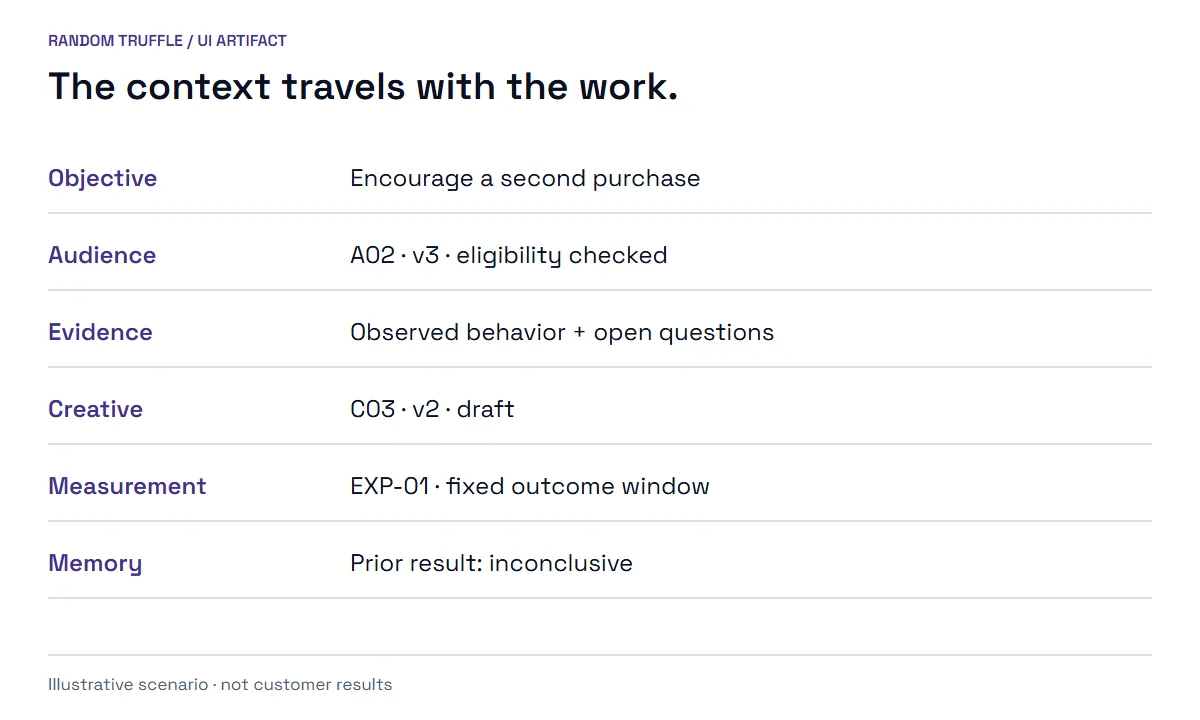
Give agents a playbook they can use
Keep brand rules and working instructions in reusable skills, with clear versions, owners and review steps.
Read the field note →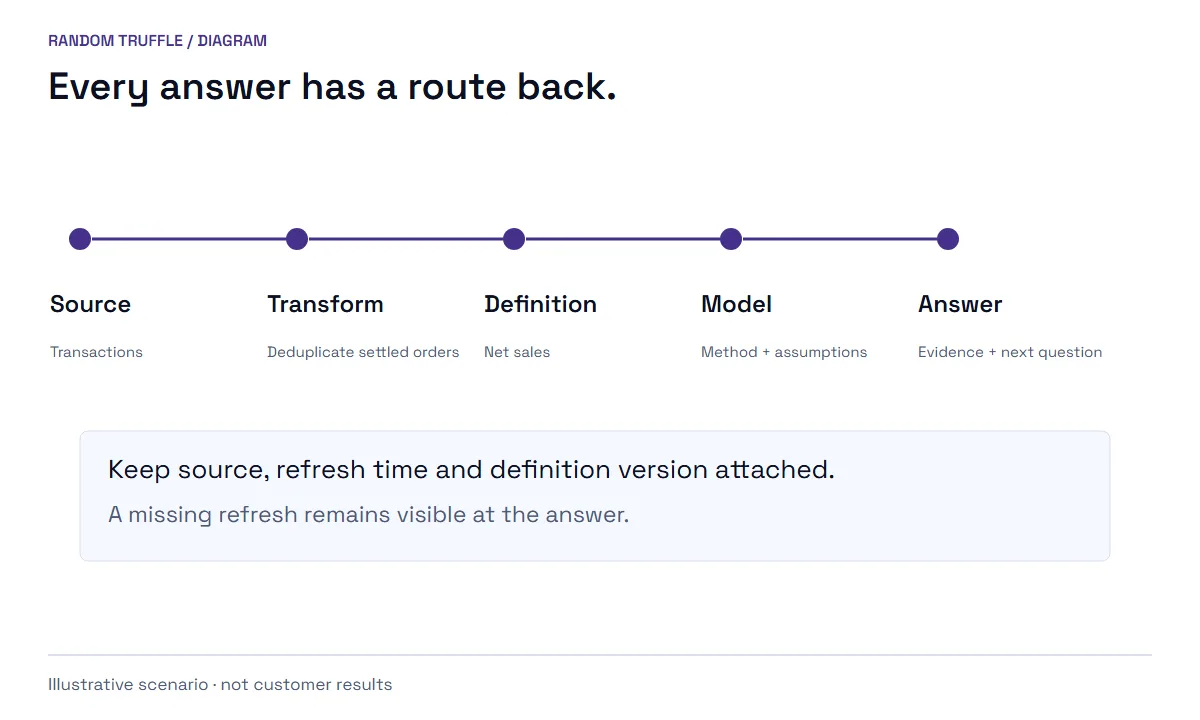 AI & marketing / 9 MIN READ
Useful AI starts with business definitions
Define the customer, conversion and business outcome before asking an agent to act on the data.
Read the field note →