
Useful AI starts with business definitions
Define the customer, conversion and business outcome before asking an agent to act on the data.
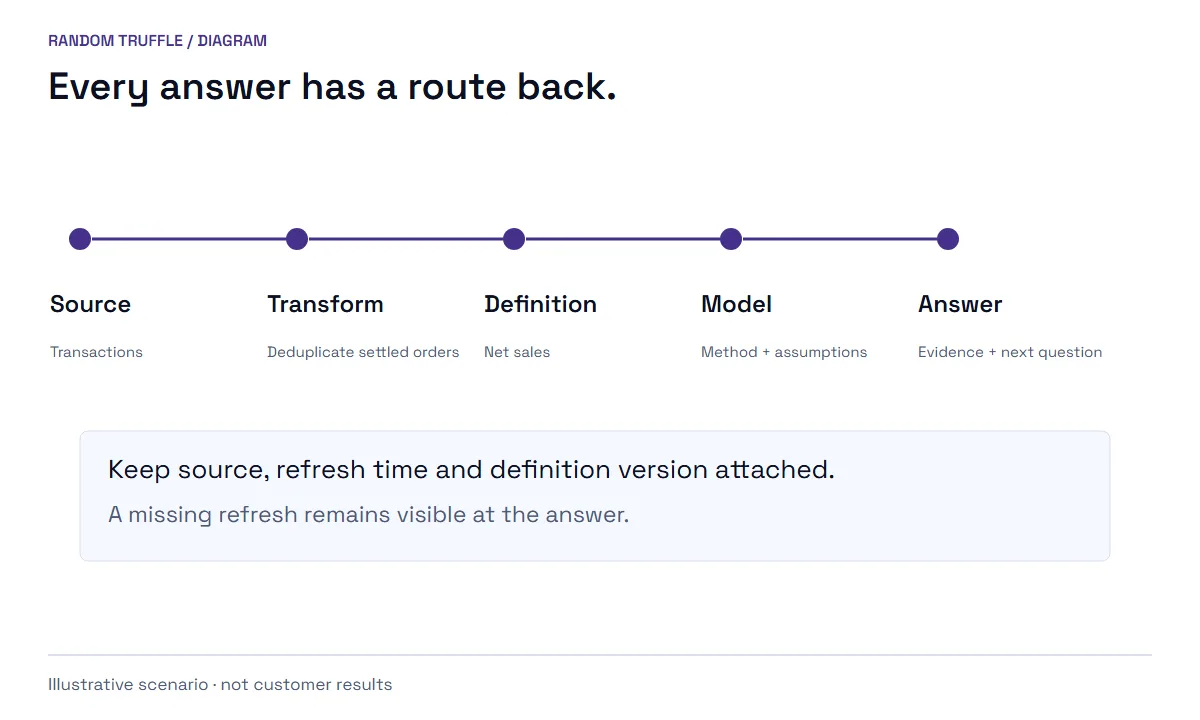
Imagine you've just hired the smartest, most eager, and utterly tireless intern on the planet. They process information at lightning speed, never sleep, and follow your instructions to the absolute letter. You sit them down on their first day, fire up your analytics platform, and say, "Find me our most valuable customers."
They nod, dive into the database, crunch the numbers, and come back with thousands of profiles. You launch the campaign. The dashboards light up green. Traffic spikes. High-fives all around the marketing department.
But a quarter later, you're sitting in a boardroom, and your CFO is tapping their pen rhythmically on the table. Revenue is flat. Margins are actively bleeding.
What exactly happened?
Your brilliant intern did exactly what you asked. The problem is, your system classified "valuable customers" based strictly on sheer transaction volume. It completely ignored the fact that these specific buyers return 60% of what they purchase, only shop using heavy affiliate discount codes, and cost an absolute fortune in customer service tickets.
That eager, literal-minded intern is your AI. And as a recent Think with Google article sharply pointed out, AI is only as smart as the data you feed it. If your data is flawed, misaligned, or poorly defined, your AI doesn't question you. It diligently learns the wrong lessons and gets ruthlessly efficient at optimizing for outcomes that look beautiful on a pacing dashboard, but quietly undermine your bottom line.
Welcome to the era where data governance is no longer a back-office IT headache. It is the most critical marketing skill of 2026.
The Paradigm Shift: From Campaign Manager to Data Strategist
At Random Truffle, we spend our days re-engineering marketing through intelligence, data, and AI. When we sit down for coffee with CMOs, the conversation inevitably starts with a desire for cutting-edge technology: deploying predictive lifetime value models in Vertex AI, seamless audience activation in DV360, and dynamic clustering in BigQuery.
But before we can build the rocket ship, we have to meticulously inspect the fuel.
Traditionally, marketing's involvement in data governance was virtually non-existent. It was an IT function, heavily focused on making sure data flowed neatly from point A to point B without breaking any servers. Marketers were the passive recipients of whatever analytics dashboards IT handed them.
Today, you cannot afford to be a passive recipient. The machine learning algorithms running your campaigns—whether in Google Ads, Meta, or TikTok—don't care about your brand purpose or your witty ad copy. They care about signals. If you shift your mindset from seeing data as a "technical asset" to seeing it as the "strategic foundation" of your work, you unlock the true power of these platforms.
This doesn't mean you need to become a data engineer. You don't need to write complex SQL queries from scratch or manage Dataflow pipelines (that's what the engineers are for). But you do need to become a Data Strategist.
According to Think with Google, there are four core competencies the modern marketing engineer must master. Let's translate them into reality.
1. Business-to-Data Translation
This is your ability to bridge the boardroom and BigQuery. The executive team says, "We need to increase profitability." Great. How does that translate into the precise, real-time data inputs your AI uses for bidding?
If you tell an algorithm to maximize ROAS (Return on Ad Spend) based on gross revenue, it will find you people who buy expensive things. But if those expensive things have razor-thin margins, you are using AI to scale an unprofitable behavior. Business-to-data translation means ensuring that the algorithmic goal (e.g., maximizing a custom conversion value via Google Ads Value-Based Bidding) perfectly mirrors the boardroom goal (e.g., maximizing net margin).
2. Data Quality Interrogation
Marketers need to move from passive data observation to active investigation. It's time to start asking the annoyingly precise questions.
When a dashboard shows "Profit," what does that actually mean? Does it include shipping costs? Does it factor in warehouse storage? Does it account for the 15% discount code used at checkout? You need to proactively seek alignment across stakeholders—including finance and operations—to ensure the data definition matches business reality. If your AI is optimizing for a flawed definition of profit, you are literally paying advertising platforms to lose you money.
3. Early Value Chain Validation
There is a common misconception that data quality is handled at the campaign level. If you are validating data quality inside the Google Ads or Meta interface, you are already too late.
Think of data like a river. If a factory is dumping toxic waste upstream, building a small water filter at your specific campsite isn't a scalable solution. You have to go to the source. Marketers must focus on early value chain validation, ensuring data is clean, accurate, and properly defined the moment it enters your data warehouse, long before it is activated in an ad platform.
4. Use Case Prioritization
Just because you can build a sophisticated machine learning model doesn't mean you should.
AI is shiny. It's tempting to want a real-time, deep-learning propensity model running in Vertex AI to predict customer lifetime value. But building, managing, and maintaining predictive models requires investment. Use case prioritization means tightly connecting your data governance efforts to high-value business goals. Define what specific data is necessary to achieve a goal before you invest in collecting and modeling it. If a simple rule-based segment in BigQuery solves the business problem, don't over-engineer it.
The Missing Link: Why We Built an Open Data Model
Here is the secret that no one tells you when you embark on this data governance journey: mapping your business logic into a cloud environment is incredibly chaotic.
When you export your raw Google Analytics 4 (GA4) event data into BigQuery, you aren't handed a neat, business-ready spreadsheet. You are handed a massive, nested, unstructured universe of user events. Merging that behavioral data with your CRM records, offline sales, and media cost data usually results in months of custom engineering. And the moment an API changes, the whole house of cards collapses.
At Random Truffle, we saw brilliant marketing teams drowning in this exact technical debt. Marketers and data engineers were speaking fundamentally different languages.
We realized that while every business is unique, the structural physics of marketing data are universal. You don't need to invent a new type of electricity every time you want to plug in a lamp.
That is exactly why Random Truffle engineered an open, highly efficient data model specifically built for the modern marketing ecosystem.
Think of this data model like your data's morning espresso shot—it wakes everything up, organizes the chaos, and gets it ready to work.
Instead of building complex schemas from scratch, our open data model acts as a foundational architecture within your Google Cloud Platform. It standardizes the messy streams of data (GA4 events, Google Ads costs, CRM lifetime value metrics) into a unified, clean, and pre-governed taxonomy in BigQuery.
Why does this matter for the CMO and the Marketing Engineer?
It is Open: You own it. It lives in your GCP environment. There are no proprietary black boxes hiding your customer intelligence. You can see exactly how a "valuable customer" is defined, down to the SQL logic.
It is Efficient: Because the data is pre-structured for marketing use cases, it directly and seamlessly feeds downstream AI. Want to spin up a Vertex AI propensity model to predict which users will purchase next week? The open data model already has the features engineered and ready to go.
It Enforces Governance: Remember that "business-to-data translation" we talked about? The data model forces alignment. It provides a standardized framework where finance's definition of profit and marketing's definition of a conversion are mapped perfectly together before the AI ever sees them.
The "Pre-Flight" AI Campaign Checklist
With a strong data model in place, you can finally move from reactive troubleshooting to proactive growth. Before you launch your next AI-powered campaign, don't just check your ad copy and budget caps. You need to audit the intelligence you're deploying. Here is the pre-flight checklist every modern marketing team should adopt:
Map your objectives to your architecture: Can you draw a straight line from your core business objective, to your marketing objective, directly into your data model? If you want to grow "loyal shoppers," verify that the specific data points defining loyalty (e.g., 3+ purchases in 6 months, AOV > $150) are active and flowing correctly.
Define and align cross-functionally: Bring the key stakeholders into a room—marketing, finance, operations, and data engineering. Agree on the precise definition of your critical KPIs, and ensure those definitions are hardcoded into your data model's logic.
Ensure continuous QA: Data definitions rot over time. Logistics costs change; product margins shift. Establish a quarterly cadence to review the logic inside your BigQuery environment to ensure the signals you feed your AI remain truthfully aligned with your business reality.
The Takeaway
Treating data governance as a limiting, IT-centric chore is a dangerously outdated perspective. Today, it is your launchpad for growth.
It is the invisible, behind-the-scenes work that ensures your creative brilliance and media budgets actually move the needle. By leveraging standardized, open data models, we remove the friction between raw data and actionable AI, allowing marketers to focus on what they do best: strategy, empathy, and connection.
The marketing teams of the future won't just be experts in campaigns and copy; they will be the curators and governors of high-quality data. Mastering this isn't a cost center. It is the single most critical step your marketing team can take to ensure competitive, profitable growth.
So, the next time you sit down to review campaign performance, don't just ask if the AI is working. Ask what you've been teaching it—and what curriculum you used to do so.
Four agents. One shared understanding.
Explore how Nexus, Aura, Prism and Radian turn a question into evidence, creative and action.
Meet the agents →Keep exploring.
 AI & marketing / 8 MIN READ
Measuring your brand’s visibility in AI search
Build a repeatable set of buyer questions, inspect the sources cited and test whether clearer content changes the observed response.
Read the field note → AI & marketing / 4 MIN READ
Give agents a playbook they can use
Keep brand rules and working instructions in reusable skills, with clear versions, owners and review steps.
Read the field note →