
Ask business questions. Inspect the evidence.
Make business data easier to explore through conversation, with definitions, sources and unresolved questions visible.
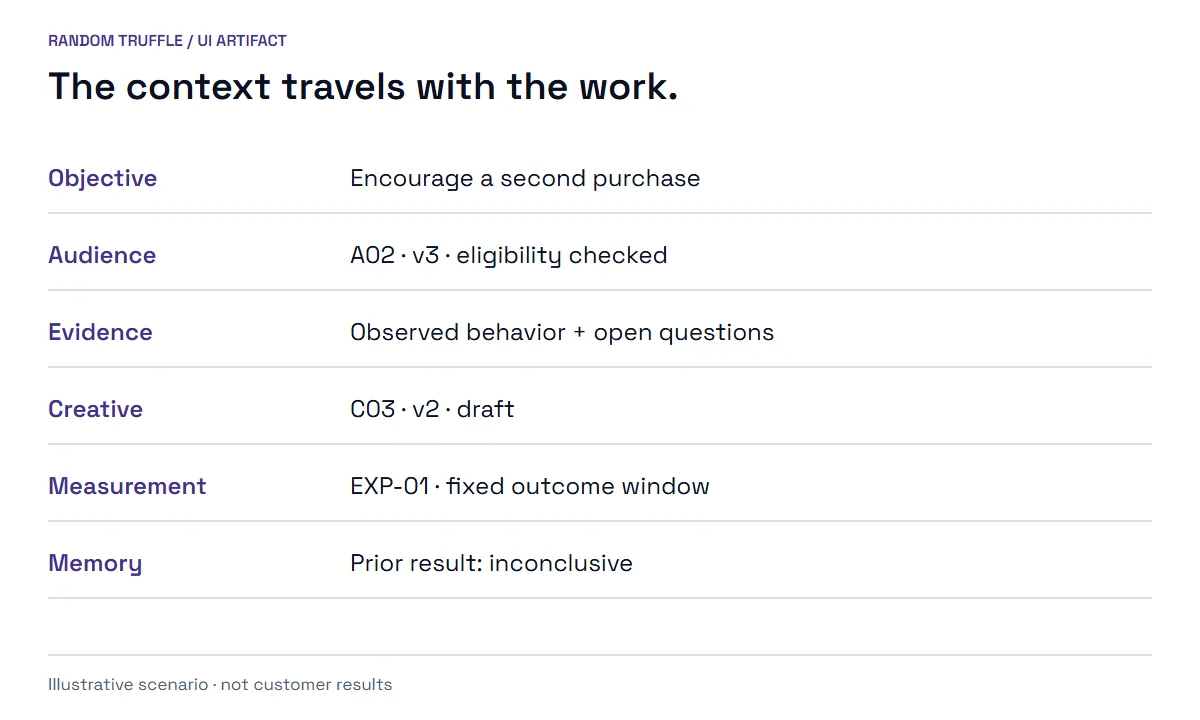
For the last fifteen years, the relationship between a Marketer and their Data has been defined by one thing: The Ticket.
You know the drill. You have a burning question. "What was the LTV of customers who bought the blue sneaker in Q3 vs. Q4?"
You can't answer it yourself because you don't know SQL. So, you go to JIRA or Asana. You write a ticket. You send it to the Data Science team. You wait three days. You finally get a spreadsheet back, only to realize you actually meant red sneakers.
So, you write another ticket. And you wait another three days.
Even in organizations with massive internal Data Science teams, this Data Dependency persists. The "Data Guy" doesn't want to be writing basic SQL queries for you; he wants to be building propensity models or optimizing warehouse costs. Yet, he is stuck spending 20 hours a week pulling lists.
This dynamic creates a bottleneck that kills curiosity. When accessing data is hard, you stop asking questions. You stop exploring. You stick to the weekly PDF because it's easy.
In 2026, this dynamic isn't just inefficient; it's obsolete.
We are entering the era of Conversational Analytics. The barrier between you and your data—the wall of code—is crumbling. You no longer need to learn the language of the machine. The machine has finally learned yours.
The CDP Lie: "Accessible" but Locked
Let's talk about the Customer Data Platform (CDP).
For years, vendors sold CDPs with the promise of "Democratizing Data." They put all your customer info in one place. Great. But then they put a complex dashboard or a rigid query builder in front of it.
If you want a standard report—something pre-baked—it's fine. But the moment you have a curious question—a question that isn't in the dropdown menu—you are stuck.
You are back to the "Insight Dependency." You are back to begging a technical resource to translate your business question into database code.
This makes no sense. The person with the business context (you) is separated from the answers by a person with the technical context (the analyst).
Enter the "Analyst Agent"
Generative AI has commoditized code generation. But Natural Language Querying (NLQ) takes this a step further by connecting directly to your enterprise warehouse.
It allows you to treat your database like a colleague, not a calculator.
Instead of dragging and dropping widgets, you simply type:
"Show me a graph of customer acquisition cost by channel for the last 6 months, but exclude the 'Influencer' campaign from May."
Under the hood, an AI Agent:
Parses your intent (Understands "CAC", "Channel", and the specific exclusion). Maps it to the schema (Finds the marketing_spend and new_customers tables). Writes the SQL (Generates a complex join query that would take a human 20 minutes). Visualizes the result (Decides a Line Chart is the best way to show this trend).
Conversation can shorten the route from a business question to an inspectable answer. Response time and completeness depend on the available sources and analysis.
Why "Generic" AI Chatbots Fail at Marketing
Now, you might be thinking: "Can't I just plug ChatGPT or a generic AI into my database?"
You can. And it will probably lie to you.
Generic LLMs (Large Language Models) don't understand Marketing.
If you ask for "ROAS," a generic model might calculate it as (Total Revenue / Total Spend).
But your business might define ROAS as (New Customer Revenue / Media Spend).
If the AI uses the wrong definition, you get a number that looks right but is strategically dangerous.
The Random Truffle Difference: It Speaks "CMO"
This is why we built Random Truffle specifically for the marketing domain. Our conversational engine isn't just a generic SQL generator. It is trained on the Semantics of Marketing.
It doesn't force you to speak like a database administrator. It allows you to speak like a marketer.
It understands Nuance: It knows the difference between "Attributed Revenue" (Last Click) and "Incremental Revenue" (Lift).
It understands Context: If you ask "Why did traffic drop?", it doesn't just show you a chart of traffic dropping. It automatically looks for correlating factors—did CPMs spike? Did a tracking tag break? It thinks like an analyst.
It speaks Human: It doesn't return a raw table of confusing column headers. It returns a narrative. "Traffic dropped 15% largely driven by a decline in Facebook Paid Social, likely due to the creative fatigue signal we detected on Tuesday."
We stripped away the "Technical Talk." You don't need to know table names. You don't need to know join keys. You just need to know your business.
Curiosity as a Competitive Advantage
When you remove the friction of querying data, something magical happens to a marketing team.
They start playing.
They start asking "What if?" questions. They start digging into anomalies. The junior copywriter can investigate which headlines resonate with high-LTV users without needing to open a JIRA ticket.
Data Democracy isn't about giving everyone a login to the SQL console. It's about giving everyone a voice.
The future of analytics isn't a better dashboard. It's a conversation.
So, what do you want to ask?
Four agents. One shared understanding.
Explore how Nexus, Aura, Prism and Radian turn a question into evidence, creative and action.
Meet the agents →Keep exploring.
 AI & marketing / 8 MIN READ
Measuring your brand’s visibility in AI search
Build a repeatable set of buyer questions, inspect the sources cited and test whether clearer content changes the observed response.
Read the field note →AI & marketing / 4 MIN READGive agents a playbook they can use
Keep brand rules and working instructions in reusable skills, with clear versions, owners and review steps.
Read the field note →