
Keep context intact between teams
Examine where the audience brief, creative decision and measurement plan get lost between teams — and how a shared working record can help.
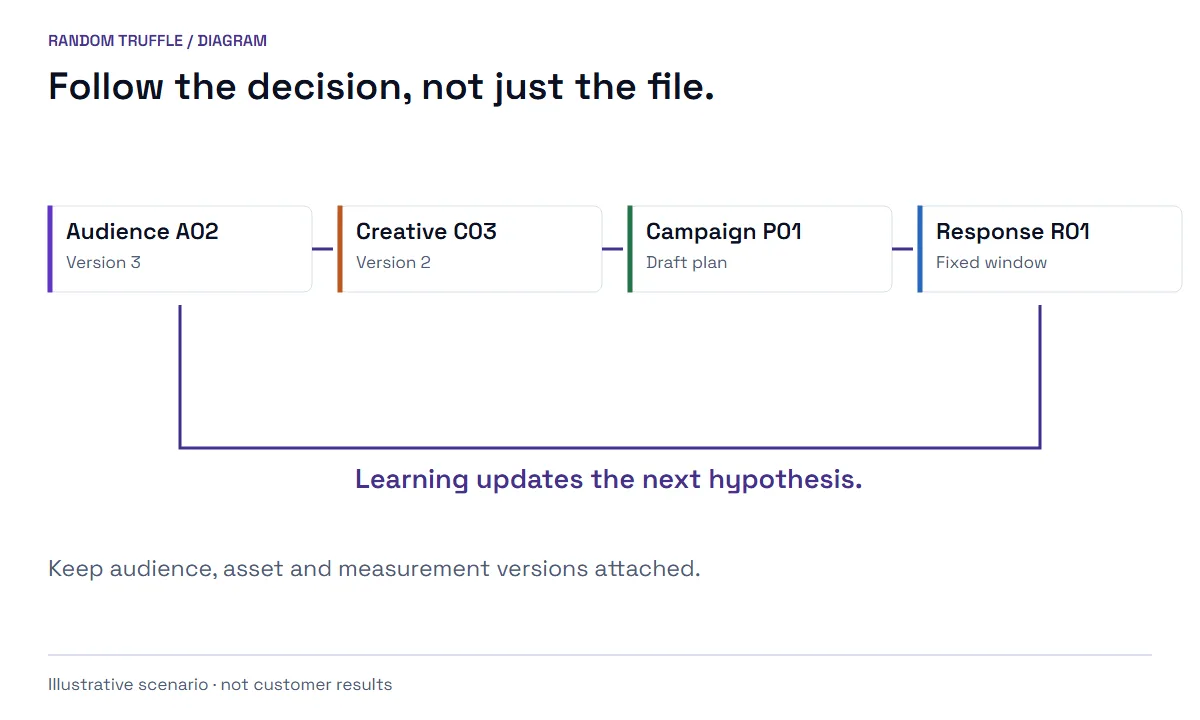
Have you ever tried to change a single headline on a live ad campaign? If you work at an enterprise brand, that sentence likely just made your blood pressure spike.
In theory, changing a few words on a display banner should take five minutes. In reality, it requires an email to an account manager, a revised creative brief, a copywriter's time, a designer's adjustments, a legal compliance review, and finally, a media buyer manually trafficking the new asset into Google Ads or DV360.
This isn't a strategy problem. It's a supply chain problem. For the last twenty years, the marketing industry has operated like an assembly line from the 1920s—a bloated, fragmented Rube Goldberg machine where humans act as routers, manually passing files and data from one siloed department to the next.
Every step in this gauntlet introduces friction, latency, and cost. It's why enterprise marketing teams spend the vast majority of their budget on the process of marketing and only a fraction on the actual algorithmic learning required to win.
From Copilot to Autopilot
Over the last year, the conversation around AI in marketing has largely centered on "copilots"—tools that help a human type a brief faster or generate a mood board. But a copilot still relies on a human pilot to fly the plane.
What we are seeing now is the transition to autopilot. Generative AI is no longer just a brainstorming buddy; it is directly automating creative production, operations, and media optimization. We are shifting from tools that simply help humans execute campaigns to systems that reduce repetitive coordination, while people remain responsible for strategy, creative judgment and consequential decisions.
By removing the human routing layer, brands can test more variations with fewer avoidable handoffs.
Enter the AI Marketing Factory
To understand where we are going, we have to look at the architecture of modern data. As capabilities inside Google Cloud Platform (GCP)—specifically Vertex AI and BigQuery—stitch together with ad platforms, the linear marketing chain becomes a continuous learning loop.
Marketing transforms from disjointed project management into an automated, self-refining production engine. Think of it less like an ad agency and more like a high-frequency trading floor.
Strategy: Humans input core business objectives, guardrails, and audience intent.
Generation: Vertex AI scales localized, format-specific creative assets.
Validation: AI Agents verify assets against strict brand and legal compliance guidelines.
Distribution: Approved versions are delivered via Performance Max and programmatic APIs.
Optimization: BigQuery processes real-time incrementality, feeding models to cull & scale.
Step 5—Optimization—is where the real magic happens. In the traditional model, optimization is a weekly report pulled by a junior analyst logging into Google Analytics. But let me be clear: GA4 is no longer just a dashboard; it's a telemetry feed.
By leveraging the GA4 BigQuery export, you capture raw, unsampled event data without the constraints of UI limits. From there, we use BigQuery Machine Learning (BQML) to run predictive models directly where the data lives. You don't need a PhD in data science to score a user's probability to convert or calculate their predicted lifetime value (pLTV).
Once scored, Vertex AI acts as the connective tissue, seamlessly pushing these high-value predictive audiences back into Google Ads as custom audience signals. Instead of bidding on everyone, your Performance Max campaigns are now executing value-based bidding exclusively on the audiences the math says will actually buy. That is what true, closed-loop automation looks like.
"You cannot optimize an AI factory on last-click attribution. When a machine can produce creative variants at scale, your measurement architecture becomes your only steering wheel."
The Measurement Imperative: MMM in the Roaring 20s
If the AI factory is the engine, how do you know you're driving in the right direction? This is where the collapse of the supply chain forces a total overhaul of marketing measurement.
With third-party cookies depreciating and privacy regulations tightening, the granular, user-level tracking of the past decade is dying. You can't rely on multi-touch attribution (MTA) to grade the homework of an AI that is dynamically assembling assets across YouTube, Search, and Display. MTA is slowly bleeding out thanks to ITP, ETP, and iOS14+ consent gaps.
Enter the renaissance of Marketing Mix Modeling (MMM). We are currently in what Google aptly calls the "Roaring 20s of MMM." Open-source, Bayesian models—like Google's Meridian—are redefining how we measure success. Unlike legacy MMMs that relied entirely on raw spend, modern models ingest nuanced data like Search Query Volume (to capture organic demand) and Reach & Frequency curves (to ensure you aren't wasting impressions by over-exposing the same audience).
But here is the secret to making MMM actionable: it cannot live in a vacuum. The smartest brands calibrate their Meridian models using continuous experiments. By running Geo-Experiments and Conversion Lift studies, we validate the model's correlation with actual, causal reality. We measure the baseline, calculate the incremental lift, mathematically extrapolate for measurement gaps (like offline sales or consent drop-offs), and feed that ground-truth back into the MMM.
Furthermore, we can no longer ignore the top of the funnel. Modern measurement requires integrating Brand Lift into this equation. By defining KPIs that link directly to business outcomes and factoring them into nested MMMs, we finally prove that brand marketing isn't just a soft cost center—it's a critical, measurable lever for maximizing downstream performance efficiency.
When you connect your AI Factory to an advanced, calibrated MMM framework, you bridge the gap between creative velocity and financial reality. You stop asking, "Which banner ad got the most clicks?" and start asking, "What is the marginal ROI of deploying an AI-generated video asset to this specific propensity audience?"
The Arms Race: Origin vs. Destination
Building this factory requires massive gravity. Unsurprisingly, two clear titans are on a collision course to dominate this new ecosystem.
Adobe: The King of Origin
Adobe controls the creative pipeline. With Firefly deeply integrated into Experience Manager (AEM), they dictate how content is born, managed, and approved. They are building the factory from the inside out, turning creative workflows into data workflows.
Google: The King of Destination
Google controls distribution and the audience. Using tools like Performance Max (PMax) backed by Gemini models, they automate asset assembly and bidding based on target outcomes. They are building the factory from the outside in.
Who wins this arms race? The marketer who controls the data layer sitting between them. If you allow a platform to grade its own homework, you lose your strategic advantage. First-party data, housed securely in an environment like BigQuery, allows you to orchestrate these powerful tools independently.
What This Means for Leaders (and Agencies)
The shift is underway.
At Random Truffle, we view this not as a threat, but as an emancipation. When you stop treating your marketing teams like routers passing files back and forth, you free them to be strategists. You free them to think about incrementality, predictive analytics, and deep customer empathy.
The Rube Goldberg machine is breaking. The factory is open. It's time to decide whether you want to operate the machinery, or let the machinery operate you.
Random Truffle. Marketing. Re-Engineered. Through intelligence, data, and AI.
Four agents. One shared understanding.
Explore how Nexus, Aura, Prism and Radian turn a question into evidence, creative and action.
Meet the agents →Keep exploring.
 AI & marketing / 8 MIN READ
Measuring your brand’s visibility in AI search
Build a repeatable set of buyer questions, inspect the sources cited and test whether clearer content changes the observed response.
Read the field note →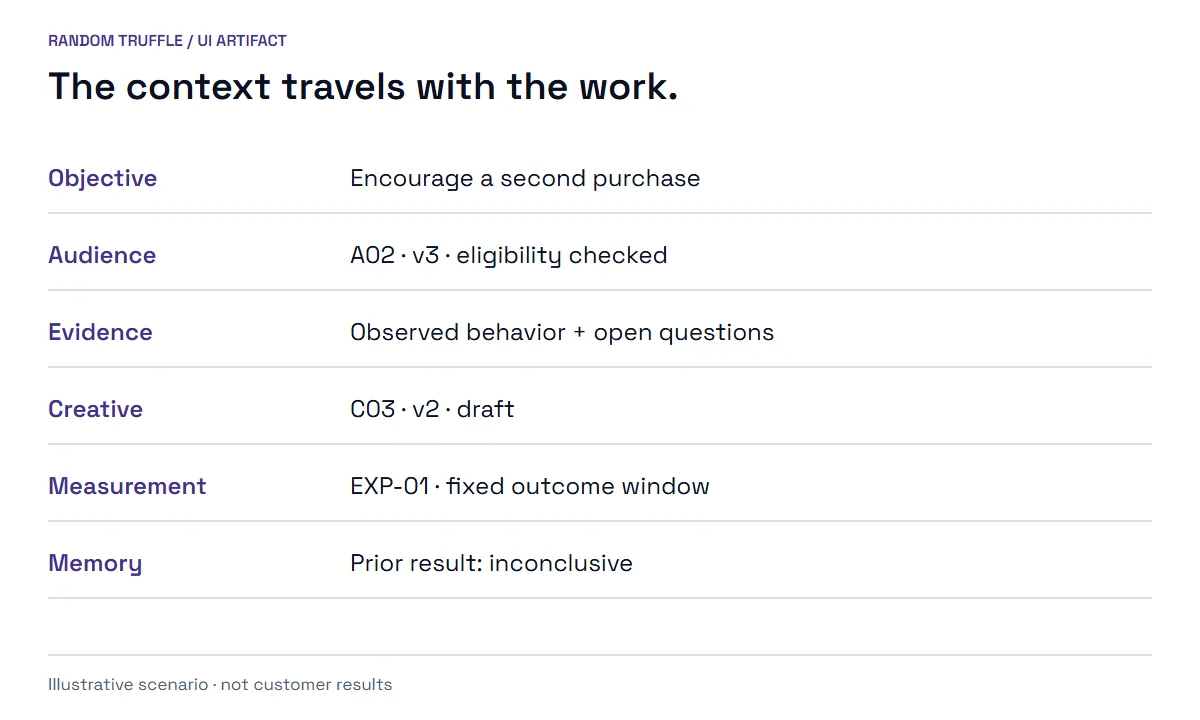 AI & marketing / 4 MIN READ
Give agents a playbook they can use
Keep brand rules and working instructions in reusable skills, with clear versions, owners and review steps.
Read the field note →