
What agents change in a marketing team
Use agents to reduce repetitive coordination while keeping people responsible for strategy, creative judgment and consequential decisions.
For the last decade, the concept of the "Modern Marketing Stack" has been somewhat of a lie.
We promised you integration. We promised you a "360-degree view of the customer." We told you that if you just bought one more SaaS tool—one more CDP, one more analytics layer, one more optimization engine—the chaos would finally resolve into clarity.
And to be fair, we made progress. But even with all that progress, we didn't realize we were still just scratching the surface.
In 2026, the average enterprise marketing team is still drowning in a fragmented archipelago of disconnected tools. You have data in Snowflake, campaigns in Google Ads, creative in Figma, and CRM records in Salesforce. And the only thing actually connecting them is a stressed-out human copying and pasting CSV files at 11:00 PM.
Disconnected systems leave people carrying context between tools. Better infrastructure can reduce that coordination work.
We are entering a new phase of marketing, where we stop trying to glue tools together by hand and start using AI agents to carry context between them.
This isn't just about automation. It's about reducing repetitive coordination while keeping people responsible for strategy, creative judgment and consequential decisions.
The Shift: From "Tools" to "Talent"
To understand where we are going, you have to change your mental model of software.
From 2010 to 2024, we bought Tools. A tool is passive. It waits for you to pick it up. A hammer doesn't build a house; a carpenter does. A marketing automation platform doesn't send emails; you do.
In 2026, we are adding Agents.
An agent is a system with a defined role, access and operating limits. People remain responsible for the objectives and decisions it supports.
Imagine setting up a Campaign Optimization Agent.
The Old Way: You log in every morning, check the CPCs, pause the losing keywords, and adjust the bids based on a hunch.
The Agent Way: You give the agent a budget, a ROAS target and the actions it may take. It monitors the campaign. When a competitor launches a flash sale at 3:00 AM, the agent detects the dip in conversion, drafts ad copy to counter the offer, proposes reallocating budget to a higher-converting geo within the limits you set, and posts the proposal in a Slack channel for you to review over your morning coffee.
You didn't "use" software. You managed a result.
The Marketing Organization: A "Swarm" Architecture
The most forward-thinking CMOs we work with at Random Truffle are no longer just building "tech stacks." They are building Agent Swarms.
A "Swarm" is a network of specialized AI agents that collaborate to solve complex problems. Instead of one giant, hallucinating "Super AI," you have a team of specialists working in concert:
The Researcher (Data Scout): Scours social listening data, Reddit threads, and competitor pricing pages. It feeds raw insights to...
The Strategist (Planner): Identifies a gap in the market ("Competitor X raised prices; sentiment is negative") and briefs...
The Creative (Maker): Generates 50 variations of ad copy and visual assets specifically targeting that pain point, then passes them to...
The Media Buyer (Activator): Prepares the approved assets and targeting parameters for Meta and Google, and starts the test once it has been reviewed.
The time required depends on data readiness, creative work, platform constraints and review. The aim is to reduce avoidable handoffs while preserving their context.
Why the "Human-in-the-Loop" is Now the "Human-on-the-Bridge"
Does this mean the end of the human marketer? Absolutely not. But it means the end of the tactical marketer.
If your value comes from knowing how to navigate the settings menu of Facebook Ads Manager or how to write a VLOOKUP formula, you are in trouble. Those are execution tasks.
The new role of the marketer is Orchestration.
Think of yourself as the Captain of a starship. You are on the bridge. You don't load the torpedoes; you don't scrub the engine core. You look at the big screen, you assess the strategic landscape, and you give the order: "Engage."
Your job is to: Set the Strategy: Define the goals (e.g., "We need to penetrate the healthcare vertical"). Audit the Output: Ensure the agents are staying on brand and compliant. Train the Skills: When an agent fails, you don't do the work for it. You update its SOP (Standard Operating Procedure) so it doesn't fail next time.
You are no longer a player on the field. You are the coach.
The Random Truffle Reality: Enterprise Governance
Now, let's talk about the reality check.
If you unleash a swarm of autonomous agents on your brand, what happens when one of them hallucinates and offers a 99% discount to your entire email list? Or breaks a privacy regulation because it "thought" it was helpful?
This is why Governance is the unsexy hero of 2026.
At Random Truffle, we believe that autonomy without guardrails is just high-speed chaos. The difference between a "cool demo" and an "enterprise solution" is the Sandbox.
We are building the Agentic Command Center. This is the layer that sits above your agents. It enforces the rules: Budget Caps: "Never spend more than $5k/day without human approval." Brand Safety: "Never use these words. Always adhere to this tone guide." Data Sovereignty: "Never send PII (Personally Identifiable Information) to an external LLM."
This lets agents take on defined work within limits your team sets and reviews.
Your Next Hire
The hiring market is changing. Alongside interviewing people, teams are starting to evaluate agent libraries.
"Does this Content Agent have a proven track record of SEO growth?"
"Can this Attribution Agent handle messy, cookie-less data?"
The companies that benefit will be the ones that give agents a defined role, access and operating limits, and keep people responsible for the objectives and decisions those agents support.
The age of the fragmented stack is fading.
Are you ready to define your first agent's role?
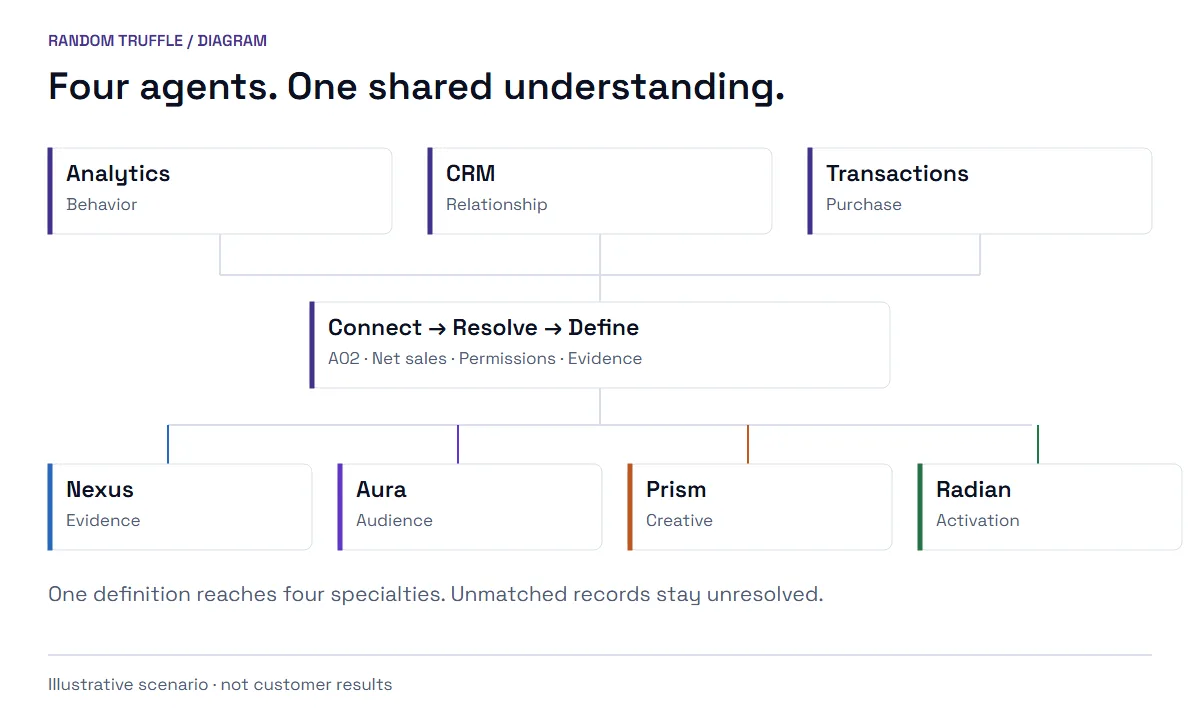
Four agents. One shared understanding.
Explore how Nexus, Aura, Prism and Radian turn a question into evidence, creative and action.
Meet the agents →Keep exploring.
 AI & marketing / 8 MIN READ
Measuring your brand’s visibility in AI search
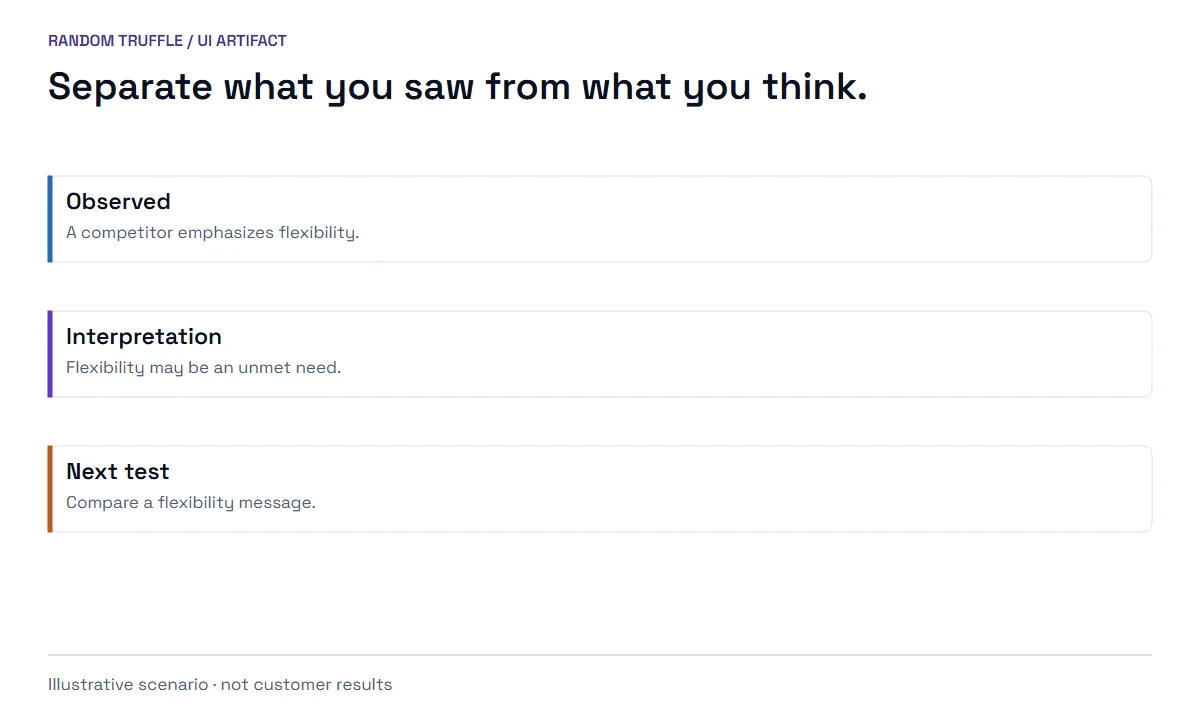
Build a repeatable set of buyer questions, inspect the sources cited and test whether clearer content changes the observed response.
Read the field note →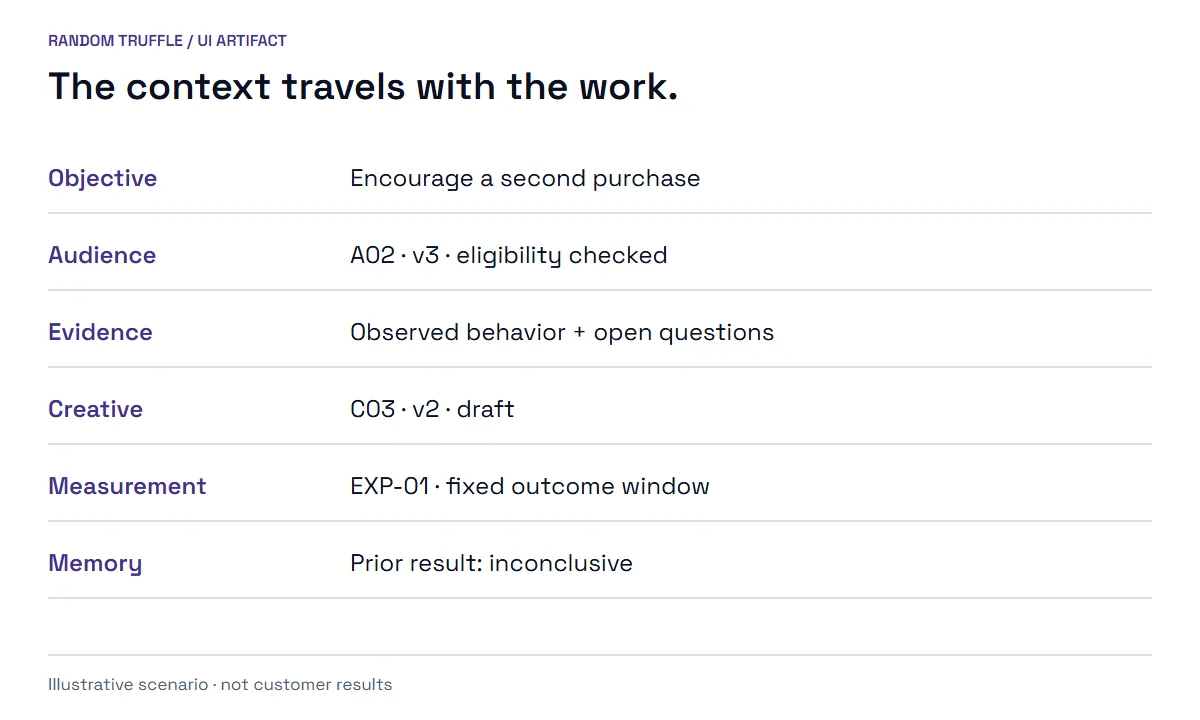 AI & marketing / 4 MIN READ
Give agents a playbook they can use
Keep brand rules and working instructions in reusable skills, with clear versions, owners and review steps.
Read the field note →