
Build predictive audiences with a clear test
Use predicted behavior to form an audience hypothesis, then test whether the intervention changes the outcome.
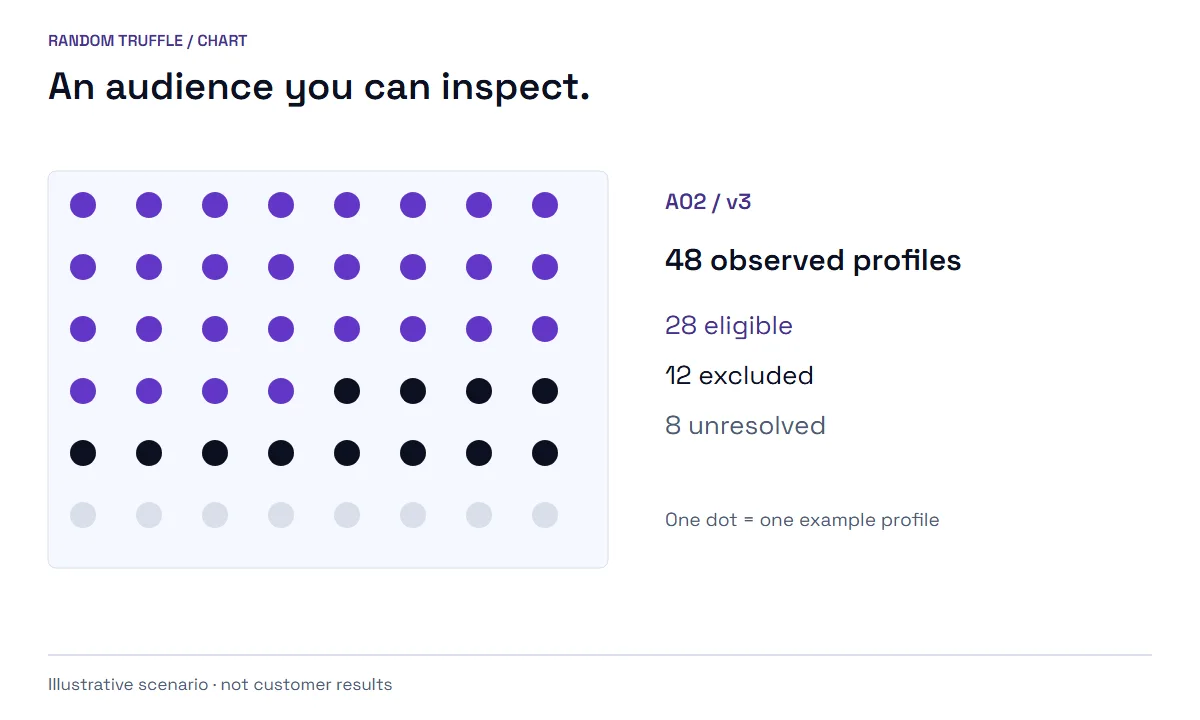
If you are still building audiences based on what people did thirty days ago, you aren't doing marketing. You're doing archaeology.
Don't get me wrong—"Added to Cart in Last 30 Days" is a classic segment. It's reliable. It's comfortable. But in an era where user privacy is tightening and cookies are crumbling, relying solely on lagging indicators is a losing strategy. You are effectively driving your marketing strategy while looking exclusively in the rearview mirror.
The modern "Marketing Engineer" looks through the windshield.
We are shifting from Descriptive Analytics (What happened?) to Predictive Analytics (What will happen?). And the beautiful secret is: you don't need a team of PhD data scientists to do it. You just need your data in the right place, and a little bit of SQL.
Welcome to the world of BigQuery ML. Let's build a time machine.
The "Propensity" Shift
The fundamental unit of the old marketing world was the Rule. IF user visited 3 times AND viewed pricing page -> THEN show retargeting ad.
The fundamental unit of the new world is the Probability. User X has a 0.84 probability of purchasing in the next 7 days.
This is called Propensity Scoring. Instead of putting users in binary buckets (Yes/No), we assign every single user a score from 0.0 to 1.0.
A purchase-propensity score estimates purchase likelihood. It does not identify who will respond because of an intervention. Test the intervention separately before using scores to justify a budget decision.
Finding them requires Machine Learning. And historically, that was hard.
SQL is the New Python
Here is why Google Cloud Platform (GCP) is eating the marketing world: BigQuery ML (BQML).
In the past, to build a churn prediction model or a purchase propensity model, you had to: 1. Extract data from your warehouse. 2. Clean it in Python/R. 3. Train a model. 4. Upload the results back to the warehouse.
SQL can make model development accessible within the warehouse. Useful predictions still require suitable features, validation and monitoring.
A model trained this way is a starting point, not a finished answer. Vertex AI runs the heavy math in the background, identifying the complex, non-linear patterns between "time on site" and "future purchase" that a human brain (or a spreadsheet) would never see.
From Data to "The Matrix"
Once the model is trained, you don't just get a report. You get a living scoring engine.
Every morning, your system runs a prediction query. It looks at every user who visited your site yesterday, feeds their behavior into the model, and appends a propensity_score to their profile.
Now, your audience strategy transforms:
The "High-Value" LTV Audience: Users predicted to spend >$500 in the next 30 days. Action: Send to VIP Sales team.
The "Churn Risk" Audience: Subscribers with a >80% probability of cancelling. Action: Trigger an automated "We miss you" email flow with a strong incentive.
The "Hidden Gem" Audience: Users who haven't visited in months but show "signals" (via third-party data or email opens) that match high-converters. Action: High-bid programmatic display.
You are no longer reacting to behavior. You are anticipating it.
The Enterprise Reality: Why "Standard" Tools Fail
Now, the skeptics among you are asking: "Can't I just click a button in GA4 to get 'Likely Purchasers'?"
Yes, you can. And for a small business, that's fine.
But Enterprise Data is different. It is messy. It is siloed. It is complex.
Your web data is in GA4. Your returns data is in an ERP system. Your loyalty status is in Salesforce. Your mobile app data is in Firebase.
A standard "out-of-the-box" ML tool only sees one slice of the pie. It might predict a user is "likely to buy" because they browsed the site, failing to realize that same user just spent an hour on the phone with customer support screaming about a refund.
This is why Random Truffle exists.
We didn't just build a tool integrated with BigQuery; we built our entire architecture on top of BigQuery.
We act as the Logic Layer for the enterprise. We ingest those disparate data sources—online, offline, CRM, support—and unify them into a single "Golden Record" within your own cloud environment.
Use permitted purchase history, product engagement and support context to define useful features and exclusions. Review whether each feature is relevant to the intended decision.
The Output: Smarter, Not Harder
When you implement predictive audiences via Random Truffle and BigQuery, the result is usually a paradox: You spend less, but you make more.
Before shifting budget, test the intervention on a scored audience against a holdout group to see whether it actually changes the outcome. You stop shouting at the crowd and start whispering to the people who are ready to listen.
The future of marketing isn't about having more data. It's about having better foresight.
Stop waiting for your customers to tell you what they want. Use the data to know what they want before they do.
Ready to start predicting?
Four agents. One shared understanding.
Explore how Nexus, Aura, Prism and Radian turn a question into evidence, creative and action.
Meet the agents →Keep exploring.
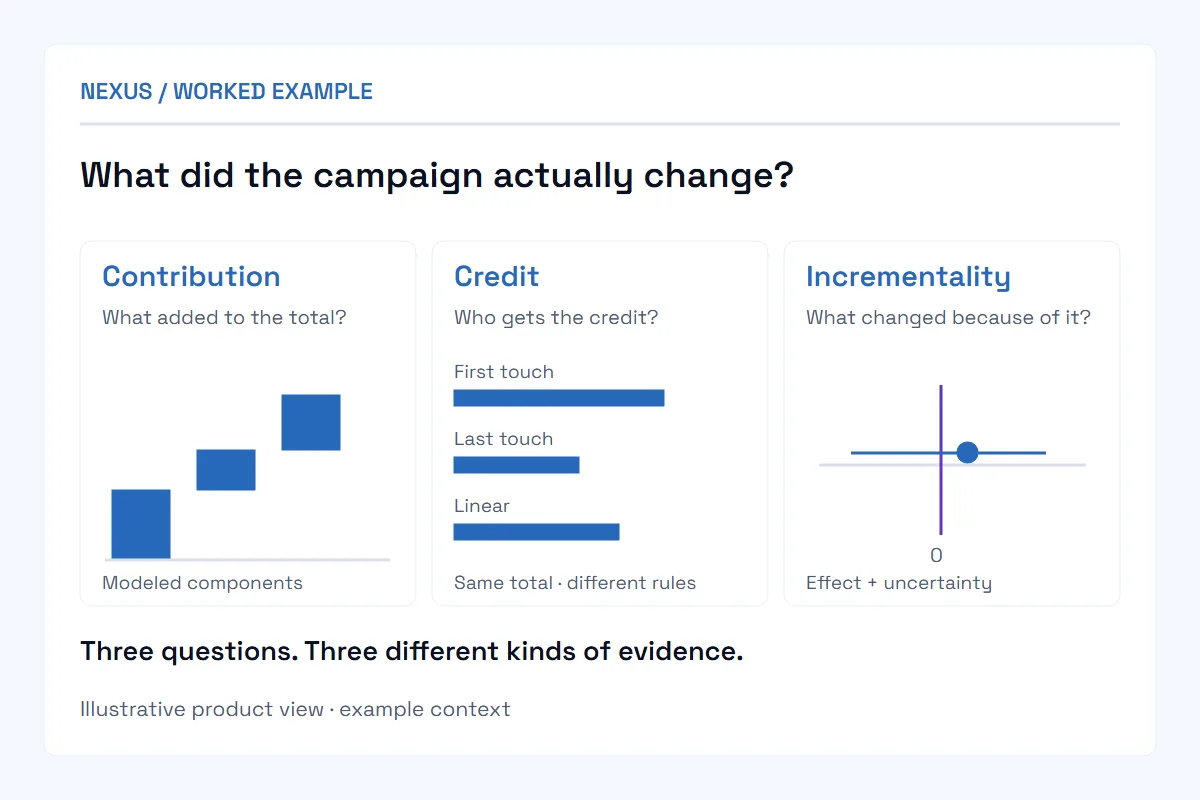 Measurement / 4 MIN READ
Contribution, credit and incrementality are different questions.
Why three useful measurement views should not collapse into a single performance number.
Read the field note →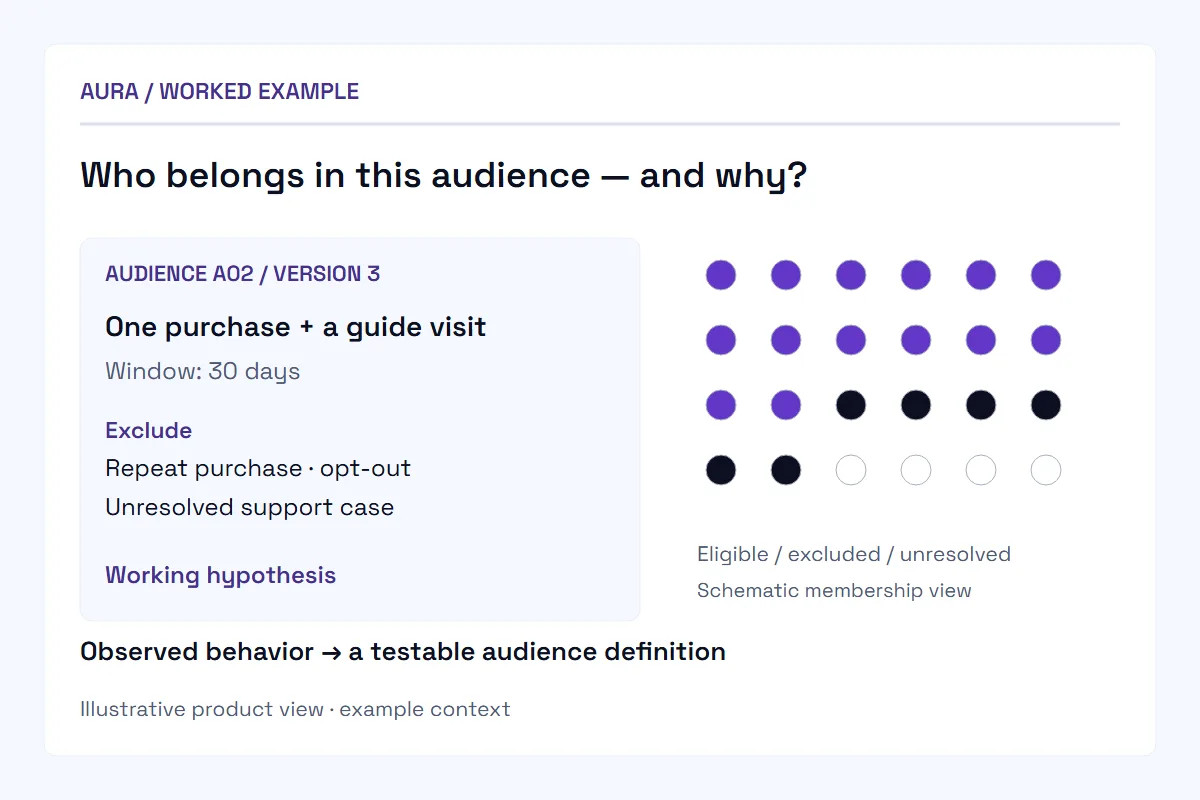 Audience intelligence / 4 MIN READ
An audience is a hypothesis, not a label.
A practical way to connect behavior, context and the next question—without pretending a segment explains a person.
Read the field note →